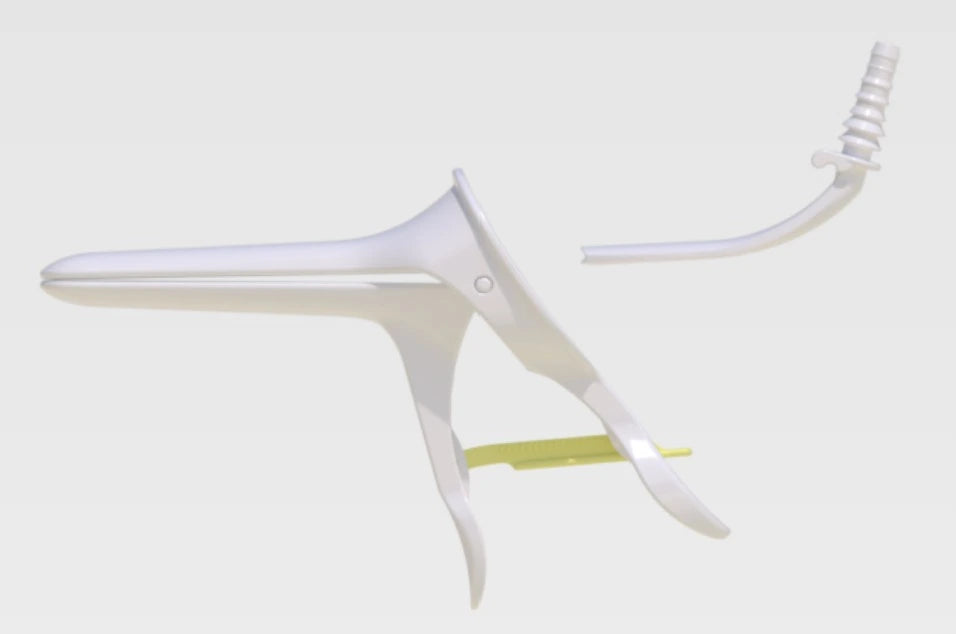


Orchid Spec SPX: The Smoke Plume Extraction Speculum Built for Modern Colposcopy
Orchid Spec SPX: The Smoke Plume Extraction Speculum Built for Modern Colposcopy
A high-quality plastic speculum with a flush smoke channel, single-handed operation, and NHS-verified strength
Colposcopy, LEEP, and laser procedures all produce surgical smoke. Managing that smoke shouldn't mean fighting with tubes that block your view or limit your instruments. The Orchid Spec SPX by Bridea Medical solves that with a smoke plume extraction channel built flush into the top of the speculum itself.
It's already a Red Dot Design Award winner (2013 and 2016), and it's the speculum that finally passed NHS break-strength testing with flying colours. Here's what makes the SPX worth a closer look.
A flush smoke-extraction channel, not a tube in the way
Most smoke extraction setups bolt a tube onto a standard speculum. That tube sits in your line of sight, gets in the way of instruments, and makes precise manipulation harder than it needs to be.
The SPX takes a different route. The smoke channel is flat and flush with the top of the speculum, integrated into the design rather than added on.
What that means during a procedure:
- Unobstructed view of the cervix and cavity
- Full freedom for instrument manipulation with nothing intruding into the working space
- Reliable smoke capture without fighting your own equipment
- Tapered nozzle that connects to most common smoke suction tubes, accommodating various air suction hose diameters
The opening is also 30% wider than standard, giving better access and a broader field of view without increasing the bill size for the patient.
Ideally suited for
- Colposcopy
- LEEP procedures
- Laser procedures
Any procedure where smoke plume extraction matters and visibility can't be compromised.
Why doctors prefer the white SPX
The SPX comes in Clean White as standard. About 95% of clients choose white over clear, even when both are available, and the reasons are practical rather than cosmetic.
- Reduced misdiagnosis. Looking through clear plastic distorts the view because tissue compresses and discolours against the transparent material. White avoids that.
- Better light reflection. The white reflective surface directs more external light to the tip of the speculum than clear or metal versions. No internal light source needed.
- Quicker examination of discharge colour against a consistent white background.
- Patient comfort. Patients perceive white as higher-quality and hygienic. Clear plastic can read as toy-like, and patients don't want to see blood or discharge during retraction.
A clear version is available for specific indications where seeing through the speculum genuinely helps, such as inspecting sutures after a hysterectomy or assessing larger conditions.
Single-handed operation with no risk of jamming
The SPX locks and unlocks with one thumb movement. No two-handed wrestling, no fidgeting with stiff mechanisms, no rattle that makes patients tense up.
The locking design includes a safety feature: if too much force gets applied, the bills close rather than break. And the operation is click-free, so there's no unsettling noise during the procedure.
This single-handed operation matters more than it sounds. It frees up your other hand for instruments, shortens the procedure, and reduces the patient's stress because everything moves smoothly.
Patient comfort built into every edge
The patient-friendly design starts with what the tissue actually touches.
- Soft rounded edges with no sharp parting lines, so there's no risk of tissue trauma or bleeding on the inside or outside edges.
- Inward folded edges that retain fluids and discharge during the procedure, meaning less dripping, less cleaning, and quicker turnaround.
- Enhanced cervix support from the flat support surfaces at the tip of the bills, allowing gentle lifting and positioning rather than pinching or scraping.
- Anti-pinching gap so the bills don't fully meet when closed, keeping any protruding tissue uncompressed.
- Outward folded outer edges that keep the opening clear of tissue and give instruments more room to move.
- 105° backward-tilted handle for greater freedom of movement, deeper insertion, and less unintended patient contact.
- Slim, organic Clean White design that reads as friendly and hygienic, reducing pelvic tension before the procedure even starts.
- No preheating needed because plastic doesn't conduct cold the way metal does.
Unbreakable plastic measurements, verified by the NHS
Plastic speculums have a reputation for breaking, which is a serious concern when one's locked inside a patient. The Orchid Spec was sent to the Surgical Materials Testing Laboratory at the NHS in Wales for force-at-failure testing.
The results from the 2015 SMTL report (15/4838/1):
|
Test |
Result |
|
Orchid Medium (10 samples) |
Mean break force of 56.00 N |
|
Orchid Wide (10 samples) |
Mean break force of 56.03 N |
|
Orchid Wide, handles clamped (10 samples) |
Did not break before load cell safety lock-out activated at over 1,050 N |
The lab confirmed it as the first speculum to ever pass their tests this convincingly. With the handles clamped to bypass the safety ratchet, the speculum withstood more than 1,000 N without breaking at all.
That's the strength behind the SPX too. Same robust plastic construction, same patented design, same NHS verification.
The SPX range: three Standard sizes, two Open-sided sizes
The SPX comes in five configurations to cover the procedures you actually do.
Standard SPX (Clean White)
|
Size |
Tip width |
Length |
|
Medium |
24 mm (0.94 in) |
110 mm (4.33 in) |
|
Wide |
33 mm (1.30 in) |
110 mm (4.33 in) |
|
Long |
33 mm (1.30 in) |
130 mm (5.12 in) |
Open SPX (Clean White)
The Open SPX adds side-opening for procedures where you need lateral access. Available in Medium and Wide.
All SPX variants share the same flush smoke channel, tapered nozzle, single-handed locking, and patented edge design.
What Theresa Freeman-Wang said
"It's the most user-friendly speculum we've seen. It offers optimal manipulation and reliable operation and it's smooth and aesthetically pleasing. Patients prefer it."
Theresa Freeman-Wang, Consultant Gynecologist at The Portland Hospital
Cost savings of up to 50% versus metal reusables
Reusable metal speculums look cheap until you count what it actually costs to keep using them. The real cost of one metal use lands between €1.43 and €3.50 once you add up:
- Daily collection and internal transport
- Rinsing, soaking, washing, and autoclave cycles
- Maintenance, inspection, and repair of medical-grade parts
- Cleaning and sterilising collection trays and trolleys
- Transport between outpatient facilities and central sterilisation
- Depreciation and replacement
- Liability exposure from cross-contamination
The Orchid Speculum costs less per patient than metal speculums.
Reduced liability from cross-contamination
Single-use means no residue from previous patients, no skipped sterilisation cycle, no damaged-but-undetected reusable returning to circulation. The cross-contamination risk that comes with reprocessing simply isn't there.
Reduced environmental impact
The sterilisation process for metal speculums burns through water, electricity, and chemicals every cycle. Switching to the SPX removes that recurring impact.
How Bridea Medical reduces the footprint further:
- Cradle-to-cradle design. Hospital waste gets incinerated at high temperature regardless. The disposable SPX effectively becomes fuel for that process, and modern waste facilities capture the heat for electricity and city heating.
- Optimised structural design. The SPX is 10-20% lighter than other disposable speculums on the market.
- Reduced packaging. Packed 10 per poly bag rather than individually wrapped. Less material, faster restocking.
- Local Dutch manufacturing in an ISO 14001:2004 certified facility built for clean, efficient production.
Bridea Medical's environmental targets
- 100% carbon neutral by 2025
- Net negative by 2030
A better speculum, a better practice, a better world
The Orchid Spec SPX exists because surgical smoke management shouldn't compromise visibility, instrument freedom, patient comfort, or hospital budgets. A flush smoke-extraction channel, single-handed operation, NHS-verified strength, patient-friendly rounded edges, and a Clean White finish that 95% of clients prefer.
Available in Medium, Wide, and Long Standard sizes, plus Medium and Wide Open-sided variants. Packed in boxes of 30 (three bags of 10).
Orchid Spec SPX: Frequently Asked Questions
What is the Orchid Spec SPX?
The Orchid Spec SPX is a single-use plastic vaginal speculum with a built-in smoke plume extraction channel. It's designed by Bridea Medical for colposcopy, LEEP, and laser procedures where surgical smoke needs to be removed without obstructing the view or limiting instrument access. The SPX is part of the wider Orchid Spec range and shares the same patented edge design, single-handed operation, and NHS-verified strength as the standard model.
What does SPX stand for?
SPX stands for Smoke Plume eXtraction. It refers to the integrated channel that captures and removes surgical smoke generated during electrosurgical or laser procedures.
Who manufactures the Orchid Spec SPX?
The Orchid Spec SPX is designed and manufactured by Bridea Medical b.v., based in Amsterdam, The Netherlands. Production takes place in an ISO 14001:2004 certified Dutch facility. Bridea Medical is the registered trademark holder, and the products are patented and design registered.
Has the Orchid Spec won any design awards?
Yes. The Orchid Spec won the Red Dot Design Award in both 2013 and 2016.
What Makes the SPX Different
How is the SPX different from other smoke extraction speculums?
The SPX has a flush smoke-extraction channel built directly into the top of the speculum, rather than a tube attached externally. This flat channel design sits level with the top of the bills, so nothing intrudes into the field of view or restricts instrument movement. Most competing solutions use add-on tubes that block visibility and make manipulation harder.
What is the flush smoke channel?
The flush smoke channel is a flat, integrated air intake on the top of the SPX speculum. Because it sits level with the speculum body rather than protruding above it, the surgeon gets an unobstructed view of the cervix and cavity and full freedom for instrument manipulation.
How much wider is the SPX opening?
The SPX has a 30% wider opening compared to standard speculums. This gives improved access and a wider field of view without increasing the bill size for the patient.
What suction tubes does the SPX nozzle fit?
The SPX has a tapered nozzle that accommodates various air suction hose diameters, allowing easy and reliable connection to most common smoke suction tubes used in clinical settings.
What procedures is the SPX ideal for?
The SPX range is ideally suited for:
- Colposcopy
- LEEP procedures
- Laser procedures
Any procedure where smoke plume extraction matters and visibility cannot be compromised.
Sizes and Variants
What sizes does the SPX come in?
The Standard SPX comes in three sizes, and the Open SPX comes in two sizes.
Standard SPX (Clean White):
|
Size |
Tip width |
Length |
|
Medium |
24 mm (0.94 in) |
110 mm (4.33 in) |
|
Wide |
33 mm (1.30 in) |
110 mm (4.33 in) |
|
Long |
33 mm (1.30 in) |
130 mm (5.12 in) |
Open SPX (Clean White):
- Medium (Open-sided)
- Wide (Open-sided)
What is the Open SPX?
The Open SPX is a side-opening version of the SPX speculum. It allows lateral access during procedures where the surgeon needs to reach in from the side. It's available in Medium and Wide sizes.
What colours is the SPX available in?
The SPX range is available in Clean White only. White is preferred because it reflects external light to the tip of the speculum, reduces misdiagnosis caused by tissue distortion through clear plastic, and reads as more hygienic and friendly to patients.
Does the SPX come in a biobased version?
The Bio version is part of the wider Orchid Spec range, made from 100% sugarcane biomass. Contact Bridea Medical directly to confirm current availability of biobased SPX variants.
Strength and Safety
Is the Orchid Spec SPX really unbreakable?
The Orchid Spec was confirmed by the NHS Surgical Materials Testing Laboratory (SMTL) in Wales as the first speculum to pass their break-strength tests with flying colours. With handles clamped to bypass the safety ratchet mechanism, the speculum withstood more than 1,050 N of force without breaking before the load cell's safety lock-out activated.
What were the NHS test results?
From SMTL report 15/4838/1 (2015):
|
Test |
Mean Force at Break |
|
Orchid Medium (10 samples) |
56.00 N |
|
Orchid Wide (10 samples) |
56.03 N |
|
Orchid Wide, handles clamped (10 samples) |
Over 1,050 N (did not break) |
What happens if too much force is applied to the lock?
The locking mechanism has a built-in safety feature. If too much force is applied, the bills close rather than break. This avoids the risk of any part of the speculum failing while inside the patient.
Is single-use safer than reusable metal?
Single-use removes the cross-contamination risk that comes with reprocessing reusable instruments. There's no residue from previous patients, no skipped sterilisation cycle, and no damaged but undetected reusable returning to circulation. This reduces hospital liability exposure.
Operation and Use
Can the SPX be operated with one hand?
Yes. The SPX locks and unlocks with a single thumb movement. The mechanism is designed to avoid jamming and operates without clicks, rattles, or other noises that can make patients tense up.
Does the SPX need preheating?
No. Plastic doesn't conduct cold the way metal does, so the SPX feels neutral against the skin without preheating.
How is the handle angled?
The SPX has a 105° backward-tilted handle. This gives the surgeon greater freedom of movement, a wider range of access, deeper insertion when needed, and reduces unintended patient contact.
Does the SPX retain fluids?
Yes. The inward folded edges retain blood and discharge during the procedure, which means less dripping, less cleaning, and quicker turnaround between patients.
Patient Comfort
Why is the SPX more comfortable than other speculums?
The patient comfort features include:
- Soft rounded blade edges with no sharp parting lines
- Inwardly extended surface edges that support the cervix gently
- An anti-pinching gap so the bills never fully meet, even when closed
- Outward folded outer edges that keep tissue clear of the opening
- Slim, organic Clean White design that reduces visual anxiety
- Plastic construction that doesn't transmit cold
Will the bills pinch tissue when closing?
No. The SPX has an anti-pinching gap, meaning the bills retain a small space between them even in the closed position. Any protruding tissue stays uncompressed.
Why is white better for the patient experience?
Patients perceive white speculums as higher quality and more hygienic. Clear plastic can read as toy-like and exposes patients to the sight of blood or discharge during retraction. White avoids both issues and helps patients stay relaxed, which makes the procedure go faster.
What's included in the true cost of using metal speculums?
The hidden costs of reusable metal include:
- Daily collection and internal transport
- Rinsing, soaking, washing, and autoclave cycles
- General maintenance, inspection, and repair
- Replacement of damaged or missing parts
- Cleaning and sterilising collection trays and trolleys
- Transport between outpatient facilities and central sterilisation
- Depreciation
- Increased liability from cross-contamination risk
Do you need to reduce staff to capture the savings?
No. Manpower is only a limited part of sterilisation costs. The savings come from reduced water, detergent, electricity, and machine wear, plus extended machine lifespan and lower maintenance.
How is the SPX packaged?
The SPX is packed 10 pieces per poly bag, with 3 bags per box (30 units per box). This reduces handling time, simplifies restocking, and uses less packaging material than individually wrapped alternatives.
Environmental Impact
Is a disposable speculum really better for the environment?
Yes, when compared to the full lifecycle of a metal reusable. The sterilisation process for metal uses significant water, electricity, and chemicals every cycle, and that contaminated water needs treatment afterwards. The disposable SPX removes those recurring impacts.
What happens to the SPX after use?
Hospital waste must be incinerated at high temperature by law, which requires fuel. The disposable SPX effectively becomes part of that fuel after use. Modern waste facilities capture the excess heat to generate electricity and city heating, completing a cradle-to-cradle loop.
How much lighter is the Orchid Spec compared to other disposables?
The structural design has been optimised for a 10% to 20% weight reduction compared to other disposable speculums on the market, which further reduces environmental impact.
What are Bridea Medical's sustainability targets?
- 100% carbon neutral by 2025
- Net negative by 2030
Where is the SPX manufactured?
The SPX is manufactured locally in The Netherlands in an ISO 14001:2004 certified facility, optimised for clean and efficient production and resource management.